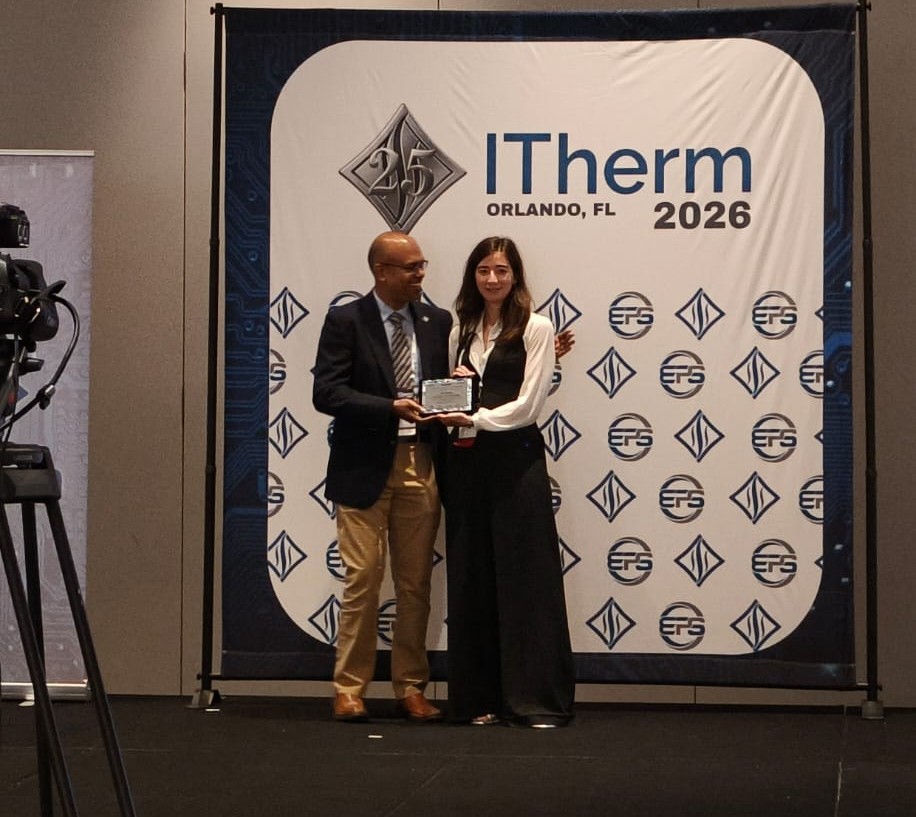
Dr. Lisa Tondelli, PhD in ICT in 2026, received the Best runner-up award at the iTherm 2026 Conference in Orlando (FL), USA. The award recognizes the relevance and timeliness of her contributions achieved in collaboration with imec (BE) during the 38th cycle PhD programme she recently completed.
Monastero di S. Domenico di Montecreto, 24-28 August, 2026
Duration: 5 days and 4 nights
Check-in: Monday, from 2 PM to 3 PM
Check-out: Friday, at 2:30 PM
Accommodation: in double or triple room
Registrations are open for the first edition of the PhD Summer Camp organized by our doctoral course. The program and the link for registrations at the address below
Monastero di S. Domenico di Montecreto, 25-29 August, 2025
Duration: 5 days and 4 nights
Check-in: Monday, from 2 PM to 3 PM
Check-out: Friday, at 2:30 PM
Accommodation: in double or triple room
Registrations are open for the first edition of the PhD Summer Camp organized by our doctoral course. The program and the link for registrations at the address below
Seminar announcement:
"Relevance in Connected and Autonomous Driving"
Luca Lusvarghi, Networked Systems Lab, Universidad Miguel Hernandez de Elche (UMH)
Wednesday May 20, 2026 9:30 am
Room P0.1 – Building MO25
Dipartimento di Ingegneria “Enzo Ferrari”
Via Vivarelli, 10
Abstract: Connected and autonomous vehicles leverage Vehicle-to-Everything (V2X) communications to continuously exchange detected objects (e.g., surrounding vehicles or pedestrians) and cooperatively extend their field of view beyond their onboard sensors' line-of-sight range. While some objects are key to planning safe and effective maneuvers, others may not be relevant and have no impact on the vehicle’s driving decisions. The exchange of irrelevant objects has a two-fold impact: first, it unnecessarily consumes communication resources, potentially congesting existing V2X networks and hindering the large-scale deployment of connected and autonomous driving; second, it unnecessarily increases the computational strain on the vehicle’s hardware (CPUs, GPUs), ultimately increasing energy consumption, onboard processing latencies, and the noise injected into downstream planning tasks. Understanding the objects’ relevance is thus key to optimizing the usage of communication and computational resources and enabling the design of more scalable and effective connected and autonomous driving systems. To this end, this talk will present novel relevance estimation techniques able to capture the relevance that surrounding objects have for a connected and autonomous vehicle. Through a set of preliminary results, it will also shed light on the key contextual elements that can influence the relevance of an object and illustrate the potential benefits that a relevance-aware filtering of the exchanged objects can have in terms of computational and communication efficiency.
Amr El Abbadi, University of California at Santa Barbara, will give a seminar on "Taming Big Data: Stream Summarization and its Many Applications". Tuesday, May 5 · 2:00 p.m., Aula P1.3, Dipartimento di Ingegneria "Enzo Ferrari".
Abstract: In recent decades, internet-scale applications have generated massive amounts of data from user interactions. To analyze this data, summary statistics are needed, but exact methods are often too slow and resource-intensive. Instead, streaming algorithms use efficient approximations with controlled errors. The focus is on data stream summarization, especially the “heavy hitters” problem, along with related challenges such as handling insertions and deletions, privacy concerns, and applications in cloud caching and network monitoring, showing the connection between mathematical methods and big data management.
La scuola è in concomitanaza con la conferenza ADBIS 2025 e I principali argomenti di ricerca discussi saranno data integration, AI-based knowledge discovery, neuro-symbolic query optimization, vector database management systems, e interactive digital storytelling.
My current role: I am currently Senior Scientist in the Gray Systems Lab (GSL; a lab named after Jim Gray, Turing Award winner) within Azure Data. My current research focus lies in the intersection between database systems and machine learning: specifically I am applying lessons from the former to make the latter more scalable and performant.
«
Well, first of all in Microsoft you can became a scientist only if you have a PhD! Secondly, the PhD helped me in jumping on the path that then led me here. In fact, my PhD was on Datalog, a logic base variant of SQL. During my studies, I met Carlo Zaniolo, professor at University of California, Los Angeles. In the last 6 months of my PhD, I visited Carlo, and eventually met with Tyson Condie, an assistant professor which recently joined UCLA. Tyson offered me a PostDoc position, and after completed the PhD, I flew to Los Angeles with my wife, were we stayed for about 3 years. Tyson was a former Microsoft researcher, and during the 3 years with me, I eventually met with my current manager, which then hired me at Microsoft. Bottom line, everything started with the PhD (and hard work).)